

When people think of traditional Pacific clothing they often picture grass skirts or bright printed fabric. In the Marshall Islands, women once wore something far more remarkable: finely plaited mats so detailed that museums now display them as masterpieces. These are the jaki-ed, and their story of near loss and revival is one of the most inspiring in Micronesian culture.
This guide explains what a jaki-ed is, how it was made and worn, why it almost disappeared, and how a new generation of Marshallese weavers brought it back.
What Is a Jaki-ed?
Jaki-ed are the finest quality mats made in the Marshall Islands, a nation of low-lying coral atolls in eastern Micronesia. The same plaiting skills produce sleeping mats, fans, baskets and even canoe sails, but jaki-ed sit at the top of the craft. When made to be worn, they were known as nieded.
Marshallese women have long been celebrated as some of the most skilled weavers in the Pacific. One tradition held that if a baby girl’s umbilical cord was placed among weaving materials, she would grow up to be a gifted weaver. Weaving was, and still is, a social activity, with girls learning from elders as women work together.
How a Jaki-ed Is Made
Preparing the pandanus
Everything begins with pandanus, a hardy tree that thrives on the atolls. Weavers use a variety called wūnmaan̄. The leaves are stripped of their spiny edges, boiled, sun-dried and beaten with wooden pounders to release their natural oils and make them soft. They are then torn into strips. For clothing mats these strips were cut narrower than an eighth of an inch, which is what gives a jaki-ed its fine, almost cloth-like texture.
Three parts, one mat
A jaki-ed is built in three parts:
- Jouj: the plain central field, woven first and often associated with purity.
- In̄in̄: the decorated border, woven separately with geometric patterns. Some designs have names passed down through generations.
- Bakwoj: a thicker seam sewn over the join to strengthen it and finish the look.
Historically, colours came from plant roots, fruit, bark and soot, and some borders used hibiscus fibre. Today natural dyes are often combined with modern ones.
How Jaki-ed Were Worn
As clothing, jaki-ed were worn in a distinctive way. An adult woman wore two mats: one covering the front and a second wrapped around from the back with its sides brought forward over the first, so both decorated borders could be seen. A long belt, the kangurngur, held them in place. Early observers reported belts of extraordinary length. Women of chiefly rank sometimes wore a third mat to protect their best mats when sitting on the ground.
Clothing also marked life stages. Young girls wore a small mat around the lower body, and a woman’s dress changed when she became visibly pregnant, signalling her new social standing. Men wore a single mat wrapped around the hips, or in different ways for work, fishing and formal occasions, and on festive days chiefs might add a fibre skirt beneath a mat.
What the Patterns Mean
A jaki-ed is more than a garment. Border motifs can point to the weaver’s ancestry, and many designs refer to chiefs and clan leaders. Repeating patterns are said to represent the descendants who inherit land rights, which is significant in a society where land passes through the mother’s line. The bakwoj seam is understood as joining the weaver’s maternal and paternal ancestry. Each mat therefore carries the identity of the woman who made it and the family she belongs to.
Decline: From Mats to Cloth
From the nineteenth century the Marshall Islands saw waves of outside influence: missionaries and traders, then colonial rule by Germany, Japan and the United States. Cotton and calico arrived with them. By the late 1800s women were already wearing small cloth dresses over their mats, and through the twentieth century woven clothing faded from everyday life.
There was one surprising interruption. During the Second World War, shipping disruptions cut off supplies of imported cloth, and women went back to weaving and wearing nieded. After the war, though, the decline continued. By the late 1990s, only four weavers were said to remain who still knew how to weave this kind of traditional clothing.
Revival: How Marshallese Women Brought Jaki-ed Back
The turning point came from museum storerooms. Old jaki-ed, some 150 to 200 years old, were rediscovered in the collections of the Bishop Museum in Honolulu. When photographs were shown to weavers in Majuro in 2006, the women were deeply moved, and the University of the South Pacific (USP) in the Marshall Islands launched a weaving restoration project under the leadership of Irene Taafaki.
Apprenticeships and workshops followed. Weavers studied the old mats to reconstruct lost techniques and designs, and in 2013 the Jaki-ed Program created the Virtual Museum of Marshallese Fine Weaving. By 2018, more than 200 women had been taught, with a core of over 20 active weavers, and an annual Jaki-ed Exhibition and Silent Auction was being held, including at the Bishop Museum itself. New jaki-ed have also been made for international exhibitions such as the Asia Pacific Triennial.
A Symbol of Resilience
For the Marshall Islands, cultural survival carries special weight. Between 1946 and 1958 the United States carried out 67 nuclear tests in the islands, displacing communities, and today the low-lying atolls face rising seas. Against that background, jaki-ed have become a powerful symbol of resistance and resilience. Marshallese poet Kathy Jetñil-Kijiner, for example, has drawn on weaving in her performance work about her homeland. Every new mat is a statement that Marshallese knowledge is still alive.
Jaki-ed and Micronesian Fashion Today
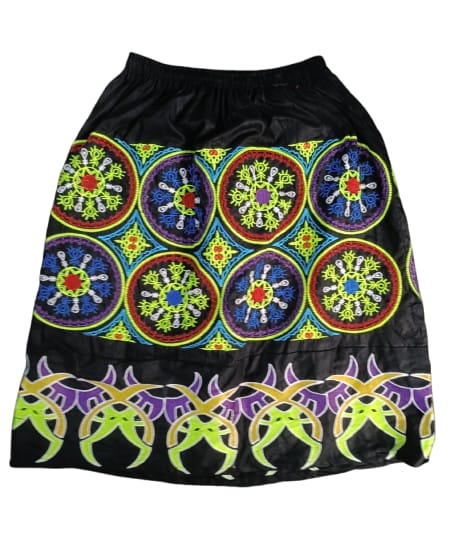
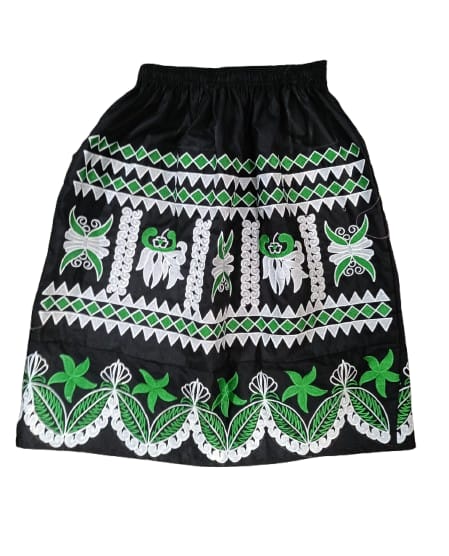
Marshallese women today usually wear cloth dresses and skirts in daily life, and jaki-ed are kept for display, gifting and special occasions. Yet the thread of continuity is clear. The long, modest skirts and dresses worn across Micronesia, from the Pohnpeian urohs to the muumuu, grew out of the same meeting between island tradition and imported cloth. Their bold borders and geometric motifs echo, in fabric and thread, the patterned edges of woven mats.
If you want to learn more about the wider picture, read our guide to Micronesian traditional clothing, or explore the patterns in our article on Micronesian skirt designs. You can also browse our Micronesian skirts collection.
Frequently Asked Questions
What is a jaki-ed?
A jaki-ed is the finest type of woven mat made in the Marshall Islands. Plaited by women from specially prepared pandanus leaves, with decorative borders that may include hibiscus fibre, jaki-ed were traditionally worn as clothing and are today treasured as art, heirlooms and symbols of Marshallese identity.
How was a jaki-ed worn?
When worn as clothing a jaki-ed was called a nieded. Women wore a pair of mats, one at the front and one wrapped around from the back so both patterns showed, held in place with a woven belt. Men wore a single mat wrapped around the hips.
What is a jaki-ed made of?
Jaki-ed are made from a pandanus variety called wūnmaan̄. The leaves are boiled, trimmed, sun-dried and beaten to release their oils before being stripped into very fine strands and plaited. Decorative borders can include hibiscus fibre and natural or modern dyes.
Why did Marshallese women stop wearing jaki-ed?
Cloth clothing spread through the islands with missionaries, traders and colonial rule by Germany, Japan and the United States. By the late nineteenth century women were wearing cotton or calico dresses over their mats, and by the twentieth century mat clothing had largely disappeared from daily life.
Is jaki-ed weaving still practised today?
Yes. In the late 1990s only a handful of weavers still knew the technique, but revival programmes led by the University of the South Pacific in Majuro have since taught more than 200 women, and new jaki-ed are exhibited and sold every year.
Sources and Further Reading
- Jaki-ed (dress mat), The Metropolitan Museum of Art
- Jaki-ed and weaving in the Marshall Islands, Smarthistory
- Marshallese women revive traditional weaving, Hawaiʻi Public Radio
- Essays on the Marshallese Past, Charles Sturt University


