

Walk into a Micronesian church service in Honolulu, Guam or Arkansas and you will see them straight away: long, colourful skirts swaying as women greet one another, chase children and carry food to the hall. For many people, this is their first introduction to the Chuukese skirt. It is one of the most recognisable everyday garments of the Pacific, yet the story behind it is rarely told.
In this guide we look at where the Chuukese skirt comes from, how Chuuk’s long contact history shaped it, why modesty sits at the heart of the style, and how the skirt became a symbol of identity for Chuukese families around the world.
Who Are the Chuukese?
Chuuk (formerly spelled Truk) is one of the four states of the Federated States of Micronesia (FSM), alongside Pohnpei, Yap and Kosrae. It is made up of the islands inside the great Chuuk Lagoon and a scattering of outer atolls such as Puluwat, Satawan and the Mortlocks. The Chuukese are the largest ethnic group in the FSM: roughly 61,500 people, close to half of the country’s population, with about 51,000 living in Chuuk State itself.
Chuukese is the main language, and English is widely spoken. The population is overwhelmingly Christian, split between Catholic and Protestant churches, and the church remains a centre of community life at home and abroad. That matters for clothing, because so much of what women wear is chosen with church, family and respect in mind.
From Woven Wraps to Cloth: A Short History of Dress in Chuuk
Before cloth: woven wrap skirts
Long before printed fabric arrived, women across the central Carolines wore wrap-around skirts woven on backstrap looms from plant fibres. On some outer islands of Chuuk and neighbouring Yap State this tradition never stopped. Hand-woven wrap skirts from Puluwat and Satawal are still worn for important events, and in Ulithi woven lavalava are worn at ceremonies and play a part in rites of passage. These woven skirts were valued possessions and gifts, not simply clothes.
Missionaries, traders and colonial rule
Everything changed in the late nineteenth century. Protestant missionaries and traders reached Chuuk in the 1880s, followed by Catholic missionaries after 1900. Germany governed the islands until the First World War, when Japan took control and developed Chuuk Lagoon as a major base. After 1945 the United States administered Chuuk under a United Nations trusteeship, and in 1986 Chuuk became a state of the newly independent FSM.
Each era brought new goods, and trade cloth slowly replaced fibre garments for daily wear. Missionary ideas about covering the body reinforced an existing local emphasis on modesty, and sewn skirts and loose dresses became the standard for women. Over the following decades island seamstresses took this imported cloth and made it their own, with bright colours, gathered waists and decorative trims.

What Does a Chuukese Skirt Look Like?
There is no single official pattern. The Chuukese skirt is better understood as a living style that changes with each generation. Most share a few features:
- Length: the hem falls below the knee, usually to mid-calf or tea length, so the thighs are always covered.
- Fabric: everyday skirts are typically cotton or nylon and other synthetics that dry quickly in the tropical heat.
- Waist: a gathered, elastic or drawstring waist that is easy to wear for long days of work and family events.
- Decoration: bold prints, floral cut-outs, lace, ribbon and embroidered borders. Observers have noted that skirts from the 1980s often used solid-coloured poplin decorated with hand-drawn scenes of daily life, while newer styles add more shine and sparkle.
- Underskirt: many women wear a slip or second skirt underneath so the fabric is never see-through.
Different islands and families have their own favourite looks, and styles linked to places such as Satawal, Puluwat, Faichuuk and Weno are celebrated at cultural shows and fashion events.
Modesty, Respect and Everyday Life
To understand why the skirt is long, you need to understand Chuukese values. Respect, deference and modesty are described as core cultural principles, and showing the thighs is considered highly improper for a woman. Men dress modestly too, and shorts are expected to reach the knee.
Modesty is tied to a wider system of respect between relatives. Traditionally, women show deference to their “brothers”, a category that includes their own brothers and maternal male relatives. A woman may avoid standing higher than a seated brother or may bend low when passing him. Anthropologists point out that this is not simply about rank: the same system gives senior women considerable influence within the family.
Because the skirt meets these expectations while still being practical, it is worn for almost everything: cleaning, cooking, fishing, playing sport and even swimming. It is, above all, an everyday garment.
Skirt or Muumuu? Knowing the Occasion
However beautiful it is, an everyday skirt is generally considered casual in Chuuk. For Sunday church and important gatherings many women wear a flowered muumuu dress, which covers the legs and arms more fully. A good rule of thumb for visitors is to match the formality of the event: a skirt for daily life and relaxed gatherings, a muumuu or a skirt with a modest blouse for church, weddings and funerals.
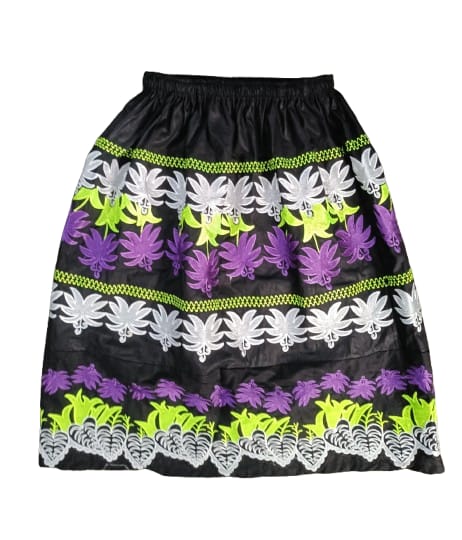
Chuukese Skirt vs Pohnpeian Skirt
Online shops often use “Chuukese skirt”, “Pohnpeian skirt” and “Micronesian skirt” as if they mean the same thing. They are related, but they come from different islands with their own histories. The Pohnpeian skirt, or urohs, began as the underskirt of the muumuu and grew into a showpiece known for embroidered motifs such as hibiscus, breadfruit and the sakau cup, usually on a dark base. Chuukese skirts cover a broader range of everyday styles, from simple printed cotton to lace-trimmed and cut-out designs.
What they share is the same purpose: a long, modest, comfortable skirt that lets a woman show her taste and her island pride. For more on the wider family of styles, see our guide to Micronesian skirt designs and patterns.
A Symbol of Identity in the Diaspora
Since the Compact of Free Association allowed FSM citizens to live and work in the United States, Chuukese families have built communities in Guam, Hawaii and across the mainland. Census figures recorded more than 4,000 Chuukese in the US in 2010, up from about 700 a decade earlier, making them one of the fastest-growing Pacific Islander groups of that period, and numbers have continued to rise since.
Far from home, the skirt has taken on new meaning. It is worn proudly at church, graduations, cultural nights and family celebrations, and it is a favourite gift between relatives. For many young Chuukese Americans, putting on a skirt is a simple, daily way of saying where they come from. You can read more about this story in our article on Micronesian skirts in the USA.
How to Wear a Chuukese Skirt Respectfully
- Choose a length that sits below the knee, and add an underskirt if the fabric is light.
- Pair it with a modest top or T-shirt for everyday wear.
- Save your most decorated skirt for celebrations, and consider a muumuu for church or formal events.
- Learn a little about the culture behind the skirt, and wear it with pride rather than as a costume.
- Wash it gently so the colours last. Our care guide explains how.
Ready to find your own? Browse our full collection of Micronesian skirts, or get outfit ideas from our guide on how to style a Micronesian skirt.
Frequently Asked Questions
What is a Chuukese skirt?
A Chuukese skirt is the long, brightly decorated skirt worn every day by women from Chuuk State in the Federated States of Micronesia and by Chuukese communities abroad. It is usually made from cotton or synthetic fabric, gathered at the waist and finished with prints, embroidery, lace or cut-out designs.
Why do Chuukese women wear long skirts?
Modesty is a core value in Chuukese culture, and showing the thighs is considered highly improper for women. A long skirt, often worn with an underskirt, keeps the legs covered while still allowing women to work, fish, swim and play sport comfortably.
Is a Chuukese skirt the same as a Pohnpeian skirt?
They belong to the same family of Micronesian skirts and are often confused online, but they come from different islands. The Pohnpeian skirt, or urohs, is known for embroidered motifs on a dark base, while Chuukese skirts cover a wide range of everyday styles, from printed cotton to lace-trimmed and cut-out designs.
Can I wear a Chuukese skirt to church?
In Chuuk, everyday skirts are generally seen as casual wear. For church and formal occasions many women choose a floral muumuu dress instead. If you are attending an event in a Chuukese community, a long skirt or muumuu that covers the knees is a respectful choice.
Can non-Micronesians wear a Chuukese skirt?
Yes. Micronesian skirts are widely worn and gifted, and wearing one respectfully, with an understanding of where it comes from, is generally welcomed. Keep the hemline below the knee, and learn a little about the culture behind it.
Sources and Further Reading
- Chuukese people, Wikipedia
- Truk: History and Cultural Relations, Countries and Their Cultures
- Lineage and gendered deference in Chuukese family values, Catholics & Cultures
- Backstrap Weaving in Micronesia, Library of Congress
- Chuukese on the Catwalk, Musings from Micronesia


